
Outsourcing link building isn’t the risky move. Handing it to a generalist SEO agency that resells you the same links at a ‘custom’ price is. Done right, link placement is the single highest-ROI SEO task you can delegate, because someone else already owns the publisher relationships you’d spend six months building.
What ‘outsource link building’ actually means
To outsource link building is to pay someone outside your company to earn or place the backlinks your site needs to rank, instead of doing that work in-house.
There are five common ways to do it, and they are not interchangeable.
- In-house hire: a full-time link builder or outreach specialist on payroll.
- Freelancer: a contractor who runs outreach or sells individual placements.
- Full-service SEO agency: a generalist that bundles link building with technical SEO, content, and reporting under one retainer.
- Link-placement specialist: an agency that does one thing — link placement — and owns relationships with both publishers and buyers.
- Marketplace: a self-serve catalog where you pick domains and check out like a shopping cart.
The rest of this guide compares what each model costs and delivers, because the model you pick matters more than the vendor’s logo.
Outsourcing link building isn’t the risk. Handing it to a generalist who resells you the same links at a ‘custom’ price is.
Why most SaaS, e-commerce, and service companies outsource links
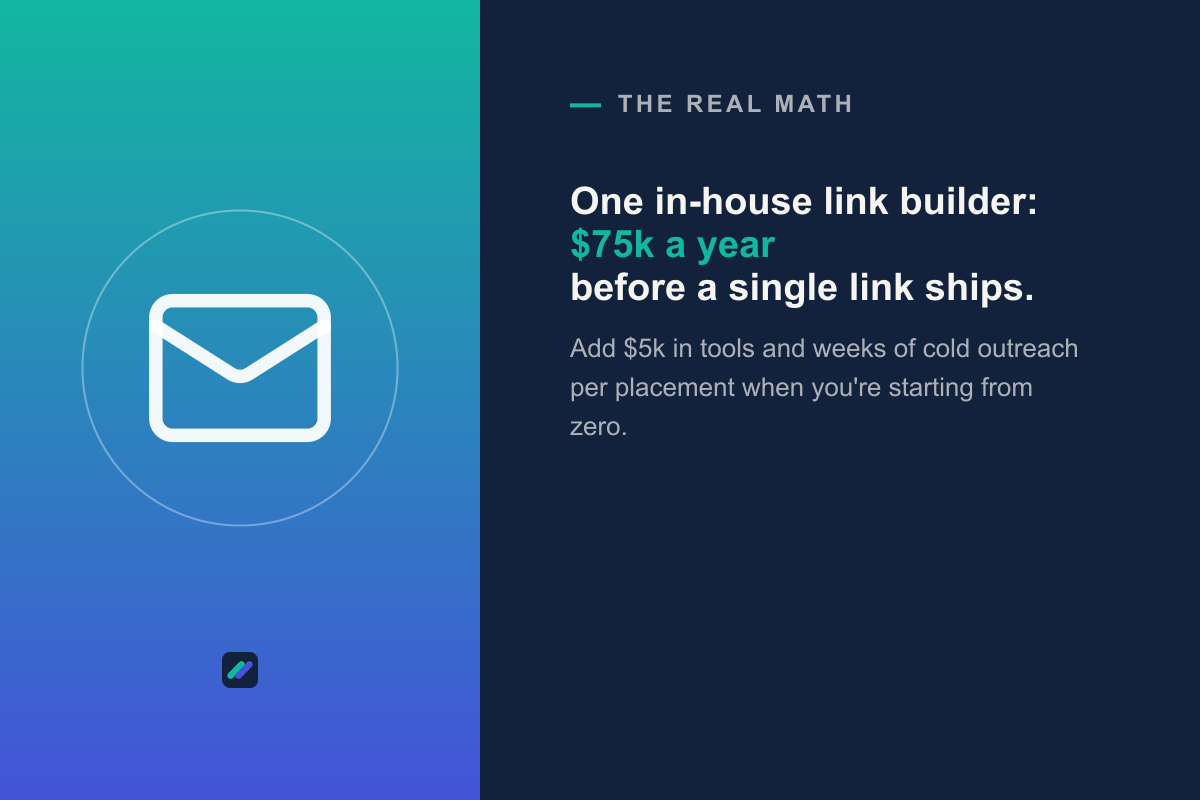
Most companies outsource links for one reason: the in-house version is slow and expensive.
A single in-house link builder costs $55,000 to $75,000 a year in salary, plus another $2,000 to $5,000 in tools like Ahrefs and outreach software.
Then there’s the ramp. Cold outreach for guest posts and link insertions gets a reply from roughly 8 to 12 percent of the sites you contact, and a yes from a fraction of those.
To land one solid link, you often email 50 to 100 publishers, negotiate terms, produce content, and chase the placement until it’s live. That’s weeks of work per link when you start from zero.
A link-placement specialist skips the relationship-building phase because it already holds the publisher list and the pricing. You’re buying back time you can’t recover any other way.
- Buy a few links at a flat per-link rate first; only move to a managed retainer once the quality holds up.
- Check real organic traffic on every sample domain yourself — never trust a DR number alone.
- Send every provider a brief with target URLs, keywords, and a defined anchor text mix before they place anything.
- Walk away from any provider with ‘custom’ pricing, no turnaround SLA, or recycled link lists.
When you should NOT outsource link building
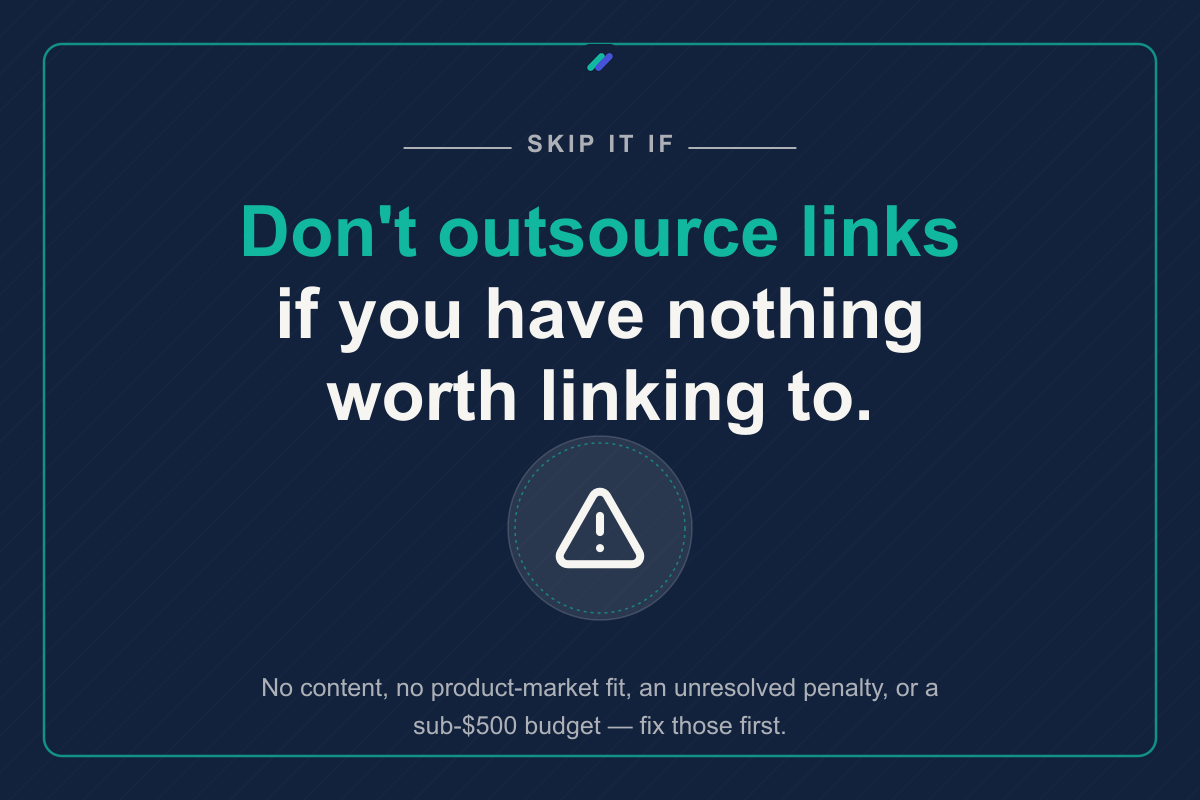
Outsourcing link building is the wrong move in four situations.
You have no content worth linking to. If your target pages are thin or purely transactional, no publisher wants to reference them, and no anchor text rescues a weak page.
You don’t have product-market fit yet. Rankings take months. If your positioning is still shifting, you’ll be building links to pages you’re about to rewrite or delete.
You have an unresolved penalty. If you’ve taken a manual action or a spam-update hit, start with a backlink audit and cleanup, not new links.
Your budget is under $500 a month. At that level, spend on content first. One or two cheap links won’t move rankings, and cheap usually means risky.
The 5 ways to outsource link building — cost and delivery
Here’s what each model really costs and what you get back.
In-house hire — $60,000+ per year. Full control, slow to ramp, and you carry the hiring risk. Worth it past roughly 20 links a month.
Freelancer — $100 to $250 per link, or $40 to $80 an hour. Flexible and affordable, but quality swings hard and one person is a single point of failure.
Full-service agency — $3,000 to $10,000 a month. Link building comes bundled with services you may not need, pricing is ‘custom,’ and many resell the exact placements a specialist would sell you directly for less.
Link-placement specialist — flat $150 to $500 per link by DR tier. Narrow scope, published pricing, a fixed 7-business-day turnaround, and one relationship to manage instead of a dozen.
Marketplace — $50 to $300 per link. Fast and self-serve, but you do all the vetting, and the listings you see are the same ones every other buyer sees.
What a good outsourced link looks like
A good outsourced link has four traits, in this order.
Do-follow. A nofollow link from a relevant site has branding value, but you’re paying for ranking value. Confirm the link type before you buy.
Topically relevant. The site and the specific article should sit in your niche or an adjacent one. A fintech link on a pet blog is a wasted link.
Real organic traffic. Domain Rating can be inflated. Check that the site pulls steady organic traffic from a country that matters to you, ranks for hundreds of keywords, and shows no strange spikes.
Placed in the body. The link should live inside the content with context around it, not in an author bio or a footer.
On tiers: DR 40-60 (Standard) covers most mid-tier pages and volume campaigns. DR 60+ (Premium) is for money pages and competitive keywords where you need more weight per link.
Red flags when outsourcing
Walk away when you see these.
- PBNs and link farms: sites with no real traffic, generic content, and outbound links to casino, CBD, and essay-writing pages sitting next to yours.
- Opaque ‘custom pricing’: if the price changes every call and nothing is published, you’re the variable being optimized.
- No turnaround commitment: ‘it depends’ with no SLA usually means months.
- Recycled link lists: the same 200 domains sold to everyone in your industry, which flattens the value of each placement.
- Irrelevant niches: ‘we’ll get you on a general business blog’ is code for we don’t have a site in your space.
- Guaranteed DR or DA numbers and bulk deals like 50 links for $99. Both point to automation, not placement.
How to vet a link building provider: a screening checklist
Run every provider through this checklist before you spend a dollar.
- Sample links: ask for 5 to 10 live placements in your niche, published in the last 90 days.
- Traffic checks: run each sample domain through a traffic tool yourself. Look for consistent organic traffic, not a DR badge.
- Pricing transparency: a real price per link or per tier, in writing, before any sales call.
- Ownership: ask who holds the publisher relationship. If they can’t say, it’s brokered three layers deep.
- Replacement policy: what happens if a link is removed or the page is deleted within 6 to 12 months.
- Reporting: a live sheet with live URL, anchor text, target page, DR, traffic estimate, and publish date for every link.
If a provider hesitates on the first three, stop there.
Pricing models compared
Flat per-link. You pay a set price for a defined asset. Easy to budget, easy to scale up or down, and you decide every target and anchor. Best for getting started and for irregular needs.
Monthly managed retainer. The provider plans targets, anchor mix, and link velocity across the month. Entry pricing starts around $500 a month. Best once you trust the provider and want consistent output without approving each order.
Performance-based (‘pay when you rank’). It sounds fair and works badly. The provider chases the easiest keywords, marks up links inside an opaque fee, and you lose control of which links get built.
The sensible path: buy a few one-off links at a flat rate, judge the quality, then move to a managed retainer.
How to brief a provider and measure results
Give the provider a brief they can act on without a dozen follow-up emails:
- Target URLs, ranked by priority.
- Primary and secondary keyword for each URL.
- Anchor text mix: roughly 40 to 50 percent branded, 20 to 30 percent partial-match, under 15 percent exact-match, the rest generic or naked URL.
- Monthly link count and any domains to avoid.
- Two or three competitor examples so they can match relevance.
Then track five things: referring domains growth, keyword positions for the target pages, organic traffic to those pages, link velocity month to month, and the indexation rate of new links.
Give it three to six months before you judge the campaign. Links don’t compound overnight.
FAQ
Short answers to the questions buyers ask most before they outsource link building.
Is outsourcing link building safe or against Google’s guidelines?
Outsourcing the work is fine; Google’s link spam policy targets manipulative links, not who builds them. The risk sits in the method — PBNs, link farms, and bulk automated placements can trigger a spam action. Do-follow links on relevant, real-traffic sites placed inside body content stay within normal risk.
How much does it cost to outsource link building?
Expect $150 to $500 per link from a link-placement specialist, priced by DR tier, or roughly $500 a month and up for a managed retainer. Full-service agencies charge $3,000 to $10,000 a month and bundle links with other work.
How long does it take to show results?
Placement takes a few days to two weeks; a good specialist caps one-off orders at seven business days. Ranking movement usually shows in three to six months.
Freelancer, full-service agency, or specialist?
Freelancer for occasional low-stakes links, full-service agency if you want strategy and content under one roof, specialist when links are the specific gap and you want flat pricing and a fixed turnaround.
What do I need to provide to get started?
A prioritized list of target URLs, keywords for each, your anchor text mix, a monthly link count, and two or three competitor examples.
How many links per month?
Five to fifteen quality links a month sustains steady growth for most SaaS and service sites; competitive niches need more.
FAQ
Is outsourcing link building safe or against Google’s guidelines?
Outsourcing the work is fine; Google’s link spam policy targets manipulative links, not who builds them. The risk sits in the method — PBNs, link farms, and bulk automated placements can trigger a spam action. Do-follow links on relevant, real-traffic sites placed in body content stay within normal risk.
How much does it cost to outsource link building?
Expect $150 to $500 per link from a link-placement specialist, priced by DR tier, or roughly $500 a month and up for a managed retainer. Full-service agencies charge $3,000 to $10,000 a month and often bundle links with other services. Freelancers and marketplaces run cheaper but shift the vetting work onto you.
How long does outsourced link building take to show results?
Placement itself can take a few days to a couple of weeks; a good specialist caps one-off orders at seven business days. Ranking movement usually shows in three to six months, depending on competition and the strength of your pages. Consistent link velocity matters more than any single placement.
Should I hire a freelancer, a full-service agency, or a link-placement specialist?
Use a freelancer for occasional, low-stakes links if you can vet quality yourself. Use a full-service agency only if you want strategy, content, and technical SEO under one roof and accept the markup. Use a link-placement specialist when links are the specific gap and you want flat pricing and a fixed turnaround.
What do I need to give a link building provider to get started?
A prioritized list of target URLs, the primary and secondary keyword for each, your anchor text mix, a monthly link count, and two or three competitor examples for relevance. Add any domains you want avoided. That’s enough for a provider to start placing without endless back-and-forth.
How many backlinks per month should I outsource?
For most SaaS and service sites, five to fifteen quality links a month sustains steady growth; competitive niches need more. Consistency beats bursts — a steady pace looks more natural and compounds better. Start lower, confirm quality, then scale.
If you outsourced one link this month, would you know how to tell whether it was worth paying for?