
Founder’s Guide · SEO
What Are Backlinks? A Founder’s Guide After 10+ Years of Buying and Selling Them
Seen the good ones, the bad ones, and the “$20 guaranteed rankings” ones.
Jalpa Patel, Backlink Expert & Founder, Linkovr · Aug 24, 2026 · 6 min read
I’ve been on both sides of the backlink transaction for over a decade, buying them for my own sites, selling them off other people’s. Most explanations of backlinks read like they were written by someone who’s never defended a link-building line item to a CFO. This one isn’t.
What Is a Backlink? (The Plain Definition)
A backlink is a link on someone else’s website that points to yours. That’s the whole definition; everything else is nuance. TechCrunch linking to your product page is a backlink; a random directory linking to your homepage is also a backlink, technically. The gap between those two is basically the entire discipline of link building.
Search engines treat backlinks as votes: a link from a trusted site passes some of that trust to you; a link from a spam farm passes the opposite. Backlinks are also called inbound links.
Why Backlinks Still Matter in 2026 (Even With AI Overviews)
Every year someone declares backlinks dead, and every year the sites that rank in classic results and increasingly in AI Overviews still have a real link profile. AI-generated answers summarize sources the model already trusts, built substantially on link authority. The bar has risen: you need enough authority to get cited as a source, not just to rank tenth.
What’s changed isn’t whether backlinks matter; it’s which ones do. Spam systems discount manipulative links more sharply each year, and the floor for genuinely valuable has risen to match.
The Backlink Types Worth Knowing
The vocabulary trips up first-time buyers. A dofollow link passes authority by default; a nofollow link (or the newer sponsored/ugc attributes) tells search engines not to pass ranking credit, though Google still weighs these as hints. Then there’s where the link lives: editorial links get added because your content earned the mention; guest post links come from contributed content through an editorial process; directory links sit in curated lists, some useful, some link farms in disguise. Knowing which bucket a link falls into is the first filter before you chase it.
What Actually Makes a Backlink Valuable
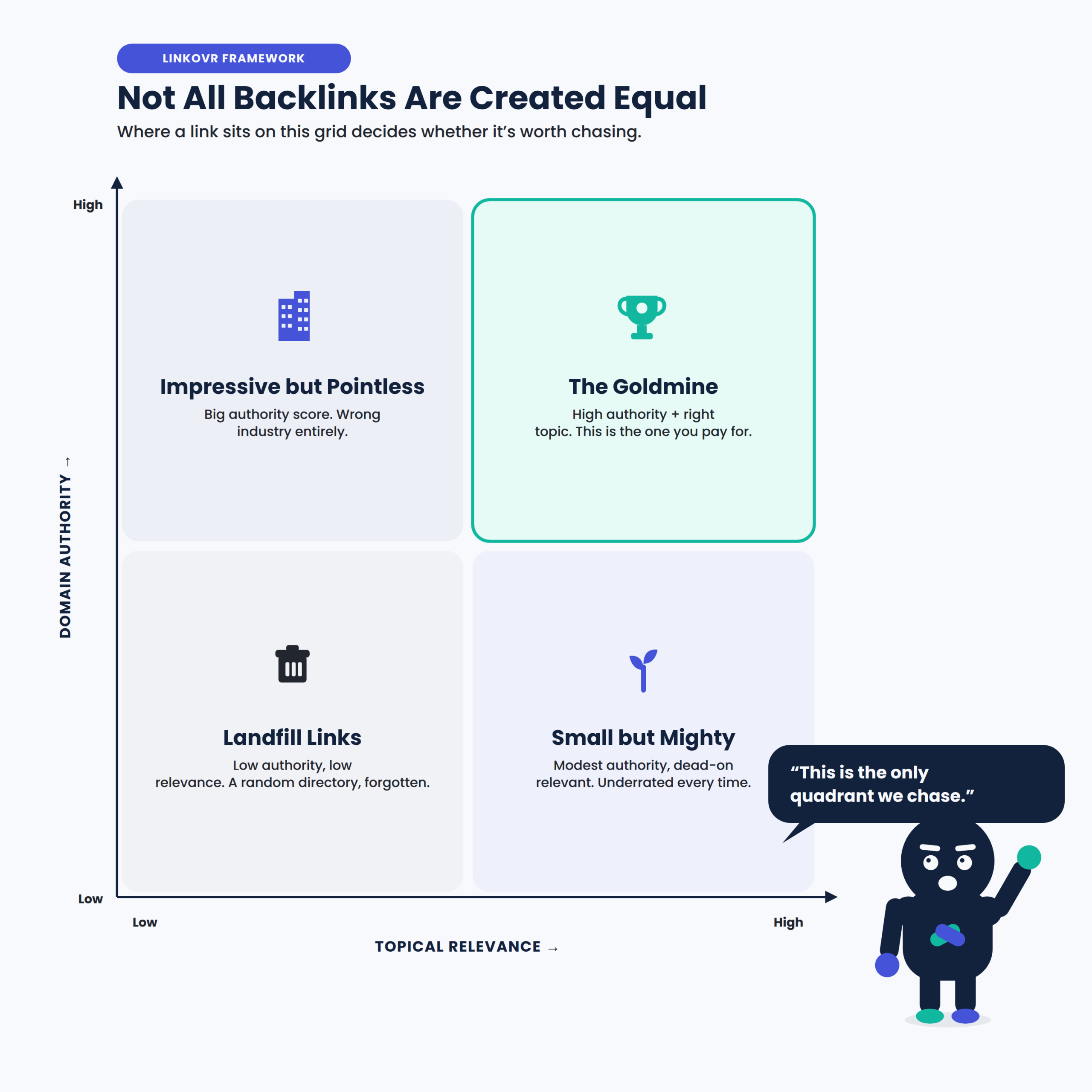
Three things decide whether a backlink is worth pursuing, not “does the site have a high number next to its name.” Authority and relevance come first — a site trusted in general and adjacent to your industry beats a huge, unrelated domain. Anchor text matters too: “accounting software for agencies” does more work than “click here.” Placement counts just as much — a link buried in a footer carries a fraction of the weight of one inside an article.
What Backlinks Really Cost — Real Numbers From the Market
Nobody in this industry likes putting numbers on this publicly, so here’s what I’ve seen change hands. A relevant guest post on a mid-authority site typically runs $150–$500, more if the site writes the content too. Links on higher-authority publications run into four figures; digital PR, paying for the pitch rather than the link, costs more but is harder to replicate.
The number that should scare a founder isn’t the price — it’s the sites selling links for $20–$50 with “guaranteed rankings.” Those exist to sell links, nothing else, and spam systems are built to find and discount that pattern.
What I’ve Learned Buying Backlinks for a Decade
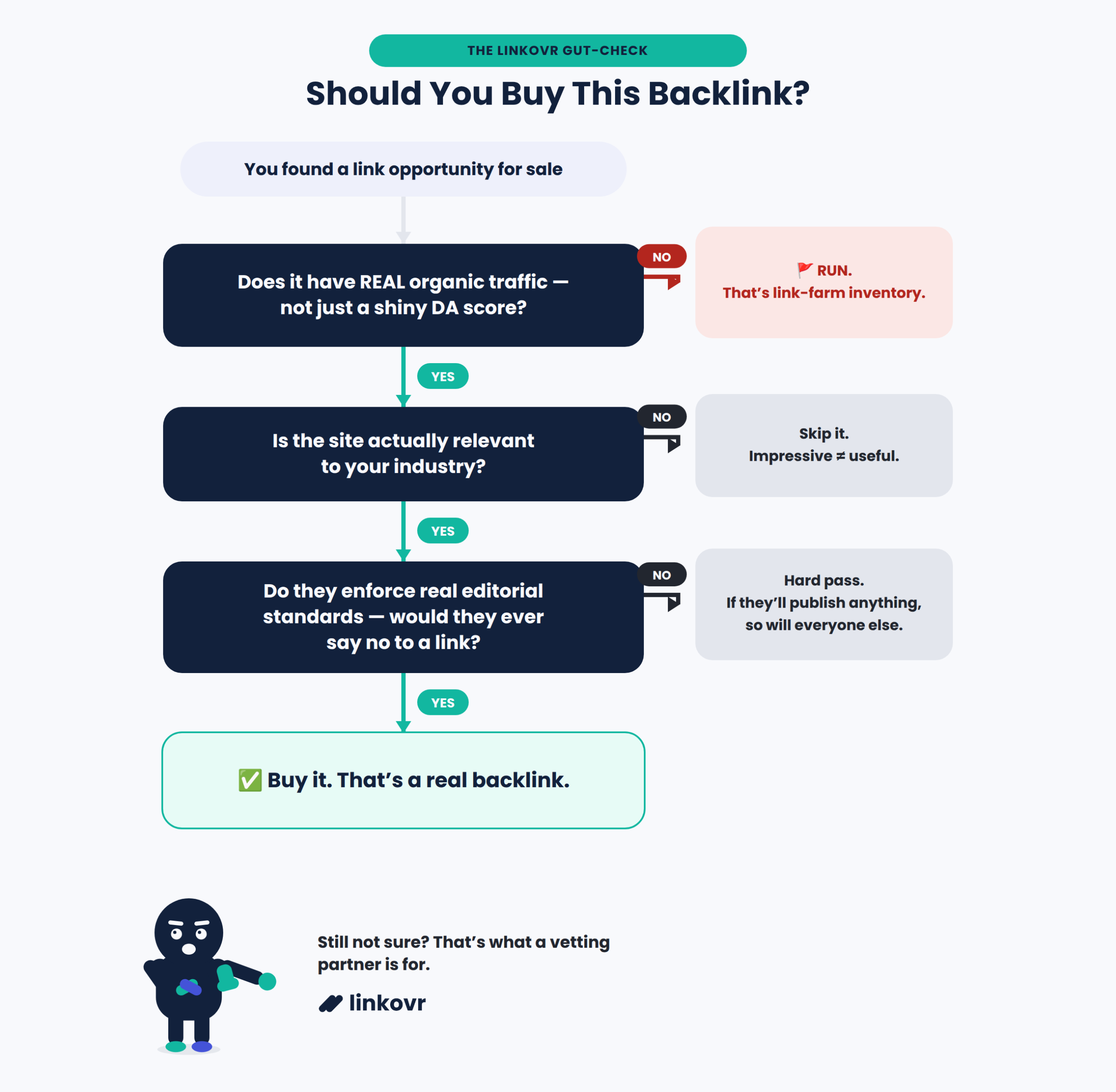
The best money I’ve spent never felt like buying a backlink — it felt like paying a writer to produce something a site wanted to publish, with the link along for the ride. The worst looked like a bargain: bulk packages promising dozens of placements for a flat fee, most sitting on network sites built to sell links to hundreds of buyers. A chunk disappeared, or got hit by a Google update, within a year. My rule now: see the actual page before paying, and check whether it has organic traffic of its own — a site with no visitors is publishing for search engines, not readers.
What I’ve Learned Selling Backlinks for a Decade
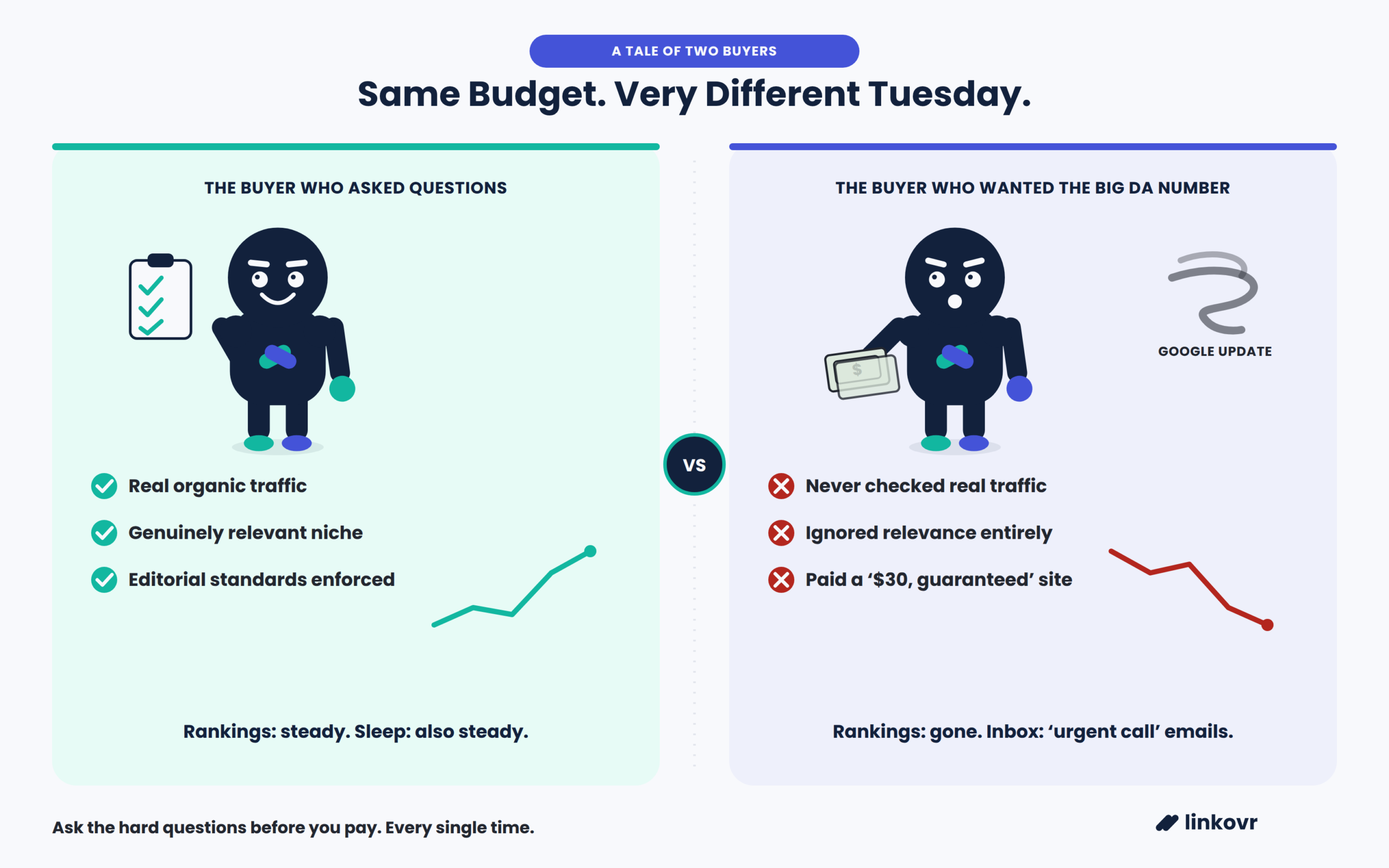
Selling links exposed buyer-side blind spots faster than buying did. The buyers who got real value asked hard questions before paying — traffic, editorial standards, how many other paid links already sat on the site. The ones who got burned cared only about a domain authority number.
I stopped selling placements on pages without existing organic traffic — a link nobody’s audience sees delivers neither the authority nor the referral traffic either side is paying for.
How to Earn Backlinks Without Paying for Them
Buying isn’t the only lever, and for early founders it shouldn’t be the first.
Digital PR and Original Data
Publish a genuinely new number — a survey, a usage dataset — and journalists link to it because it’s useful.
Broken Link Building
Find dead links on relevant sites and offer your own resource as the replacement; slow, but the acceptance rate is real.
Guest Posting Done Right
Find a site whose audience overlaps with yours and contribute something their readers would bookmark — the link is a byproduct, not the point.
How to Spot a Toxic or Low-Quality Backlink
A few tells show up consistently: little to no organic traffic despite a high authority score, anchor text stuffed with exact-match commercial keywords, content that exists to house links rather than inform anyone. Check a link against your own traffic before and after it appeared — a good link correlates with steady performance; a toxic one often precedes a drop you’ll eventually disavow.
Should You Buy Backlinks in 2026? My Honest Take
Cautiously, and only from a source you’d trust enough to publish your own name next to. The wholesale link-farm approach has been dying for years, and every update makes it more obvious. What still works is paying for access: a writer’s time for a genuinely earned placement, a PR team to pitch a real story, or a link-building partner who vets every site the way you’d vet it yourself — real traffic and editorial standards checked before a link goes live, not a slot sold in a network.
That’s the model Linkovr runs on — hand-picked placements on sites with real audiences, not link-farm inventory sold in bulk.
FAQ
What is a backlink in SEO?
A hyperlink on another website pointing to a page on yours — a trust signal search engines use as a core ranking input.
Do backlinks still matter in 2026?
Yes, for rankings and AI-generated summaries alike. Manipulative links matter less each year; genuinely authoritative ones matter more.
How much do backlinks cost?
Legitimate guest posts run $150–$500 on mid-authority sites, more on higher-authority ones. Anything at $50–$100 with “guaranteed rankings” comes from a link farm.
Is buying backlinks against Google’s rules?
Google prohibits buying or selling links that pass ranking credit without disclosure. The real risk is a profile heavy with manipulative links, which updates are built to discount.
How many backlinks do I need to rank?
There’s no fixed number, it depends on keyword competitiveness and competitors’ link profiles. A handful of relevant links outperforms hundreds of low-quality ones.
Want a link profile built the way this article describes?
Hand-picked placements on sites with real traffic and real editorial standards, vetted before you pay, not after.