
Does Link Building Still Work in 2026 (and Beyond)?
Spoiler: it survived Penguin, it survived AI Overviews. It just got pickier.
Linkovr Team · Aug 20, 2026 · 8 min read
Does Link Building Still Work? The Short Answer
Does link building still work in 2026? Short answer: yes, but not the way it worked in 2015. Volume-based tactics are dead — relevance, real editorial judgment, and topical fit now do the heavy lifting that raw backlink counts used to. If your mental model of link building is still “get as many links as possible,” that’s the part that’s broken, not the practice itself.
The debate resurfaces every year for a reason: link building is expensive, slow, and easy to do badly. When a marketing budget gets tight, it’s the first line item someone questions. The honest answer is that it still works — for teams doing it with intent, and not for teams treating it as a numbers game.
What Actually Changed Since the Old Link-Building Playbook
Search engines used to treat backlinks almost like votes — more links meant better rankings, full stop. That model created an entire industry of link farms, reciprocal-linking schemes, and paid text-link brokers built purely to game the count.
From Link Farms to Penguin, in 30 Seconds
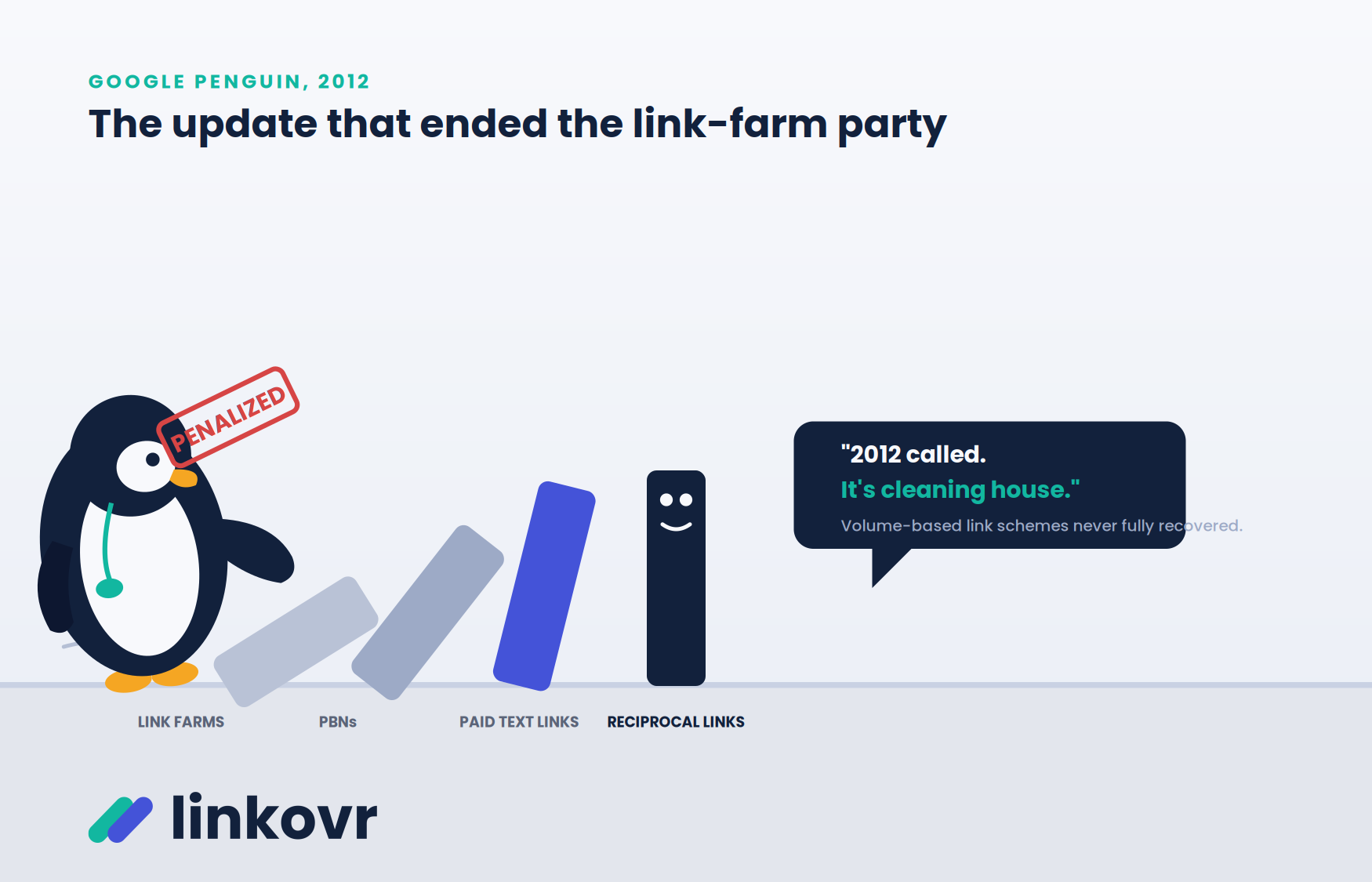
The 2012 Penguin update rewired that incentive structure almost overnight, penalizing sites that leaned on manipulative link schemes instead of earned ones. Agencies that had built their whole model around volume either pivoted to real outreach or disappeared. That shift, more than any single update since, is the real dividing line between old and current link building.
What the Data Actually Shows About Links and Rankings
Every major correlation study of the last few years — from Semrush’s ranking-factors research to Backlinko’s search-results analysis — finds the same pattern: pages ranking in the top three organic positions consistently carry stronger, more topically relevant backlink profiles than pages ranking ten spots lower. Correlation isn’t causation, but the pattern holds across enough independent datasets that it’s hard to dismiss as noise.
What the data doesn’t show is that quantity alone drives that gap. Sites with fewer, more relevant links regularly outrank sites with larger but scattershot link profiles. That’s the whole argument for doing this carefully instead of at scale.
Do Links Even Matter for AI Overviews and AI Search?
This is the real question behind “does link building still work” in 2026 — not whether Google’s classic algorithm still rewards links (it does), but whether that even matters now that AI Overviews sit above the results. Pew Research found that users click a traditional organic result in just 8% of searches that trigger an AI summary, compared with 15% when no summary appears — so the stakes of ranking at all have shifted even where the underlying mechanics haven’t.
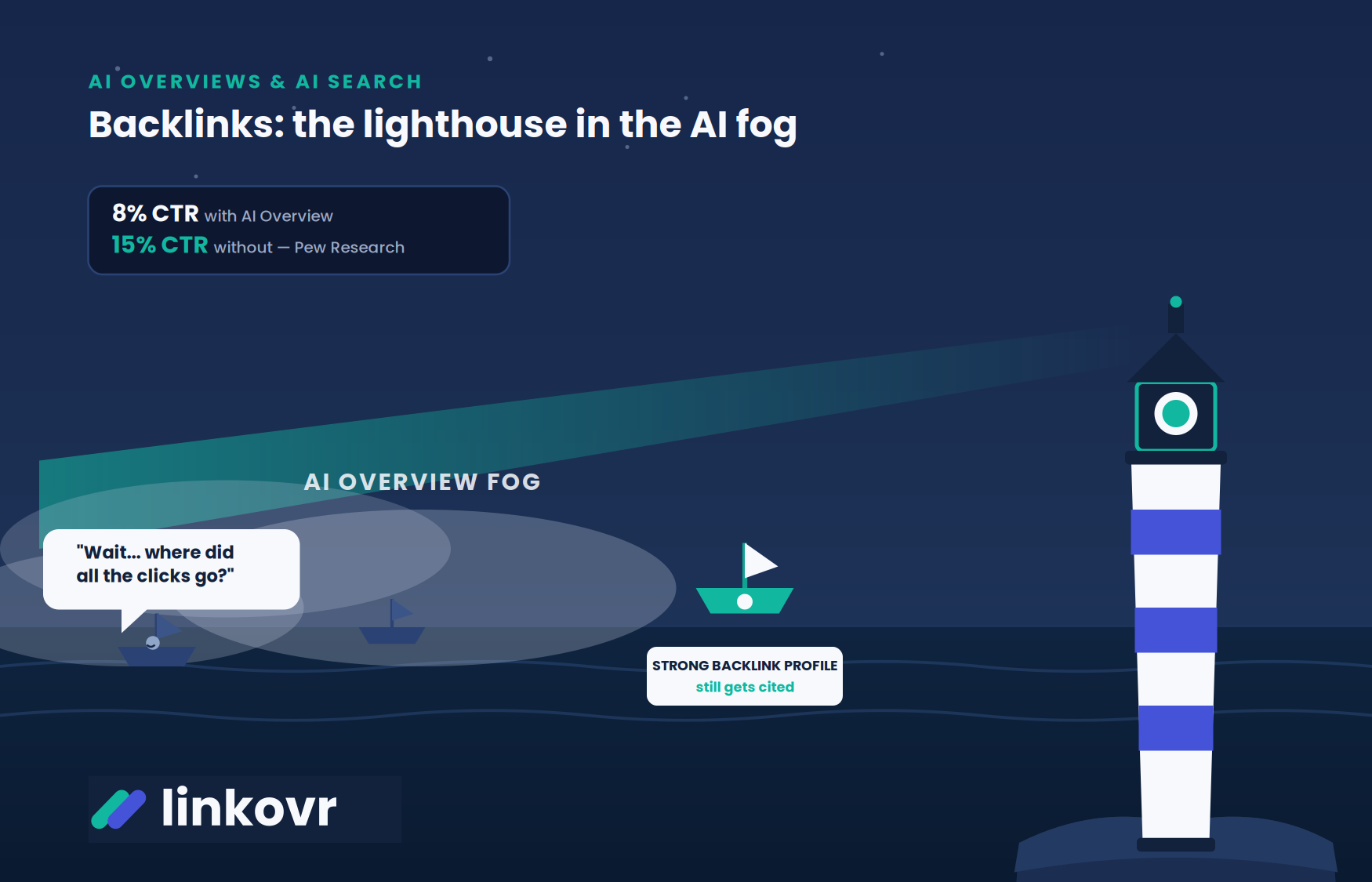
The pages AI Overviews actually cite still skew heavily toward sites with established topical authority and a real backlink profile. AI search engines are pulling from the same trust signals classic search always has; they’re just surfacing the answer differently. Link building isn’t optional in that world — it’s arguably more load-bearing, because it’s still one of the clearest signals separating a source worth citing from one that isn’t.
The Tactics That Still Work in 2026
Digital PR and Earned Coverage
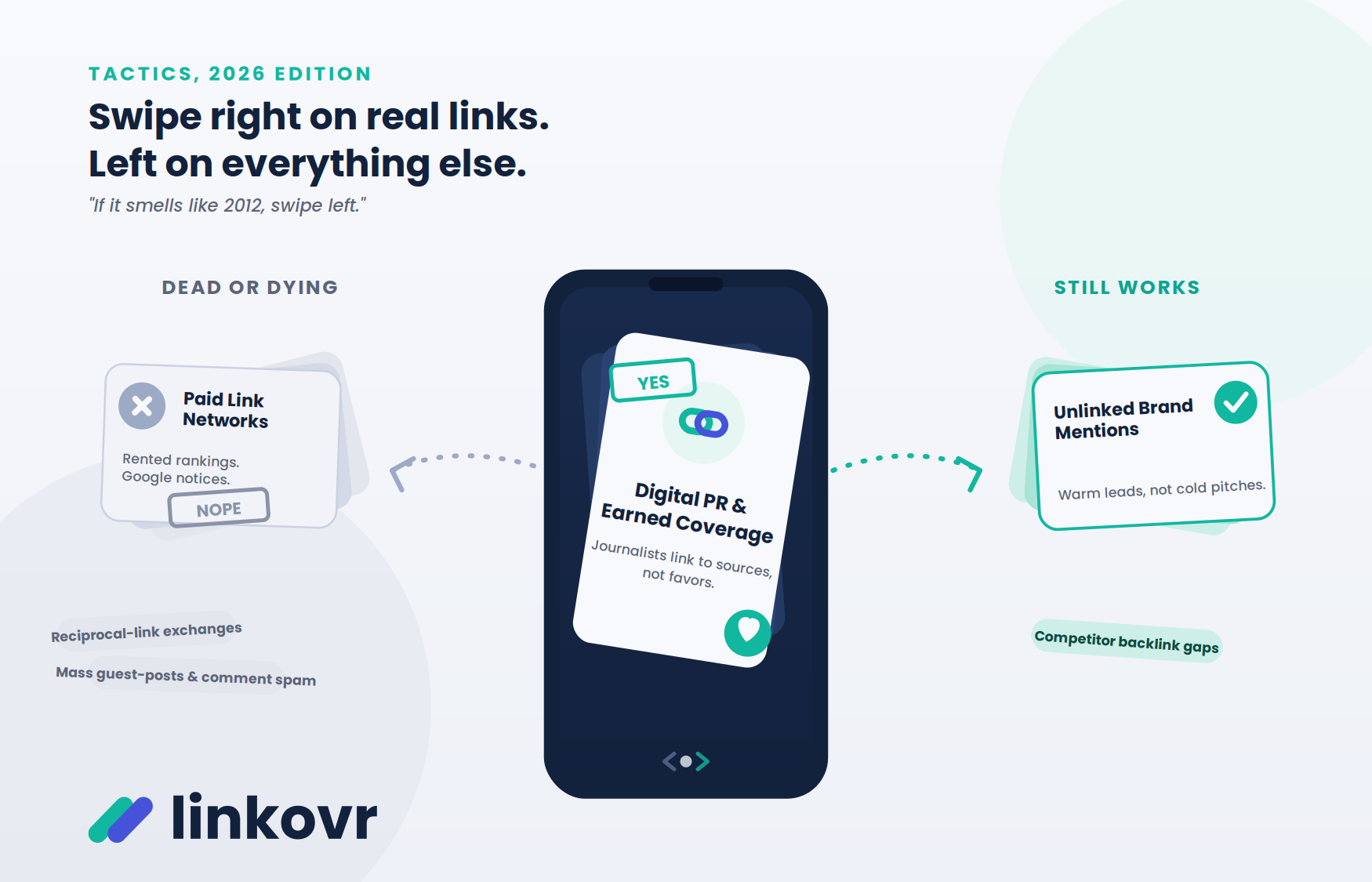
Getting genuinely covered — a data study, a founder quote, a real news hook — still earns some of the strongest links available, because journalists and editors link to sources, not favors. Selective, well-targeted do-follow guest posts still work too, on sites with actual readerships, not on domains that exist purely to sell placements.
Competitor Backlink Gaps
Finding sites that already link to two or three of your competitors but not to you is one of the highest-converting outreach angles that exists — you’re not cold-pitching a stranger, you’re pointing out a gap they’ve already shown willingness to fill.
Unlinked Brand Mentions
Any site that’s already named your brand without linking to it is a warm lead, not a cold one. A short, polite ask to turn that mention into a link converts far better than generic outreach because the relationship groundwork is already done.
The Tactics That Are Dead (or Dying)
Paid link networks, reciprocal-link exchanges, and mass guest-post campaigns on sites that will publish anything for a fee are liabilities now, not assets — they sit squarely inside Google’s own link spam policies, and getting caught costs more in recovery time than the links were ever worth. Automated blog-comment links and forum-signature links stopped moving rankings years ago; they’re mostly just noise a spam filter ignores.
How to Tell If Link Building Is Actually Working
Rankings alone are a lagging, noisy signal. Track referring domain growth — not raw link count — organic traffic to the specific pages you’re building links to, and whether your target keywords are climbing for those pages specifically, not just the site overall. Most teams see meaningful movement only after a sustained few months of consistent placements, which is exactly why link building tends to work better as a monthly link-building retainer than as a one-off sprint.
So, Is Link Building Worth It?
For a site with real content worth linking to, yes. Link building remains one of the few levers that reliably moves both classic rankings and AI-search visibility at the same time, whether that’s through hand-vetted link placements or earned digital PR coverage.
For a site with thin or duplicate content, no amount of link building fixes that first. Links amplify what’s already there; they don’t manufacture authority out of nothing.
FAQ
Is link building still relevant to SEO?
Yes. Every major ranking-factors study still finds a strong link between backlink profile strength and organic ranking position — the tactics changed, the underlying relevance hasn’t.
How much does link building typically cost?
Costs vary widely by niche and site authority — from roughly $70–$150 per placement on smaller, relevant sites, up to several thousand dollars for high-authority digital PR coverage. Check our public rate card for real, published numbers instead of a “call us” quote.
Does link building work for small or local businesses?
Yes, often faster than for large sites — local and niche-relevant links (local press, industry associations, partner sites) carry outsized weight for smaller domains competing in a narrower space.
Will AI search make link building obsolete?
The opposite looks more likely: as AI Overviews compress how many organic clicks a page gets, the sites that do get cited are disproportionately the ones with strong topical authority — which link building still builds faster than almost anything else.
Want links like the ones in this article?
Hand-vetted placements, competitor gap outreach, and unlinked-mention recovery — done with the same intent this post argues for.